Office Location is Irving, Texas and Albuquerque, New Mexico
Stay updated on the latest immigration news and policy changes. See what's changed.
Office Location is Irving, Texas and Albuquerque, New Mexico
Published By:

The legal information presented on this page reflects the professional oversight of Attorney John W. Lawit and the attorneys at John W. Lawit, LLC. It is provided for informational purposes only and does not constitute legal advice or create an attorney-client relationship.
At John W. Lawit, LLC, we strive to ensure the information presented here is timely and accurate. For legal guidance specific to your individual case, please contact our firm directly. Nothing in this article should be interpreted as legal advice.
Quick Summary: Can the Government Take Away Your U.S. Citizenship?
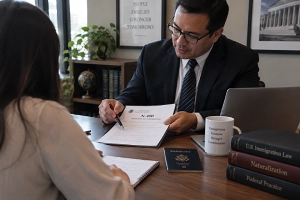 Becoming a U.S. citizen takes years of forms, fees, interviews, and waiting. Once that process is over, citizenship likely feels permanent. So when headlines mention denaturalization, it is understandable to wonder whether the government can really take that status away.
The short answer is yes, but only in limited circumstances. Denaturalization requires the federal government to prove specific legal grounds and follow established procedures. Citizenship cannot simply be revoked without cause. Understanding when denaturalization is legally possible can help separate real risk from speculation.
Most people who start asking this question have not done anything wrong. Usually it is something small and ordinary that stirs the worry back up, and the same handful of situations tend to show up again and again:
What ties these together is a fear of looking backward, and that instinct is not entirely wrong. Almost every theory that lets officials cancel a certificate points to something that was already a problem the day it was issued, not to anything that happened afterward.
Most of the damage in these cases happens early, often before the denaturalization process ever reaches a lawyer’s desk. It is rarely the government’s first letter that causes the real trouble. It is what someone does in the days right after receiving it, while still working off fear instead of facts.
The worst damage is usually self-inflicted, and it happens in the first two weeks. An envelope arrives, panic sets in, and people do something that feels reasonable but proves costly later:
Correspondence about citizenship is not always the opening move. It can be a records request or a notice tied to someone else’s file. Even when it is the real thing, the federal statute that governs revocation of naturalization still gives a person facing a civil action sixty days to answer, so there is room to respond rather than a door closing the moment the envelope arrives.
That window is used well or poorly depending on experience. John W. Lawit has practiced immigration law for more than 40 years, with bar admissions in New Mexico, Texas, Pennsylvania, and Canada, and knows which letters have historically preceded litigation, an advantage no forum can supply.
Citizenship revocation runs on rules, not official mood. The Immigration and Nationality Act, at 8 U.S.C. § 1451, lets a federal court cancel a certificate that was illegally procured or procured through concealment of a material fact or willful misrepresentation. That covers two families of denaturalization grounds: a basic requirement like residence or good moral character that was never actually met, or something hidden or misstated that mattered enough to affect the outcome.
Beyond those, the grounds U.S. Citizenship and Immigration Services (USCIS) applies in revocation reviews also reach a dishonorable discharge before five years of honorable military service, and membership in certain proscribed organizations within five years of the oath.
No agency can quietly cancel a certificate on its own. Only a federal district court has that authority, and the government carries the entire burden of proof, at the clear and convincing evidence standard. That case usually starts as a civil complaint filed by the Department of Justice, though a separate criminal route exists too, carrying the added risk of prison time rather than just the loss of citizenship.
Can the government really take away your U.S. citizenship over an honest mistake? That fear drives most of what circulates online, and the law’s actual answer is narrower than the rumor.
Some worries cause needless fear more than real risk. Not every error counts as naturalization fraud, an omission only matters if it tended to influence the government’s decision. A forgotten address is not willful misrepresentation either, ordinary memory gaps are treated differently than deliberate concealment.
Other beliefs swing the other way, into dangerous overconfidence. There is generally no statute of limitations on the civil side, so time alone does not close the door. The criminal statute also reaches further than most assume as the federal offense of unlawfully procuring naturalization carries penalties reaching ten years, and longer in cases involving terrorism or drug trafficking. Nor does explaining things directly to an officer settle anything, since materiality and intent are legal arguments made to a judge.
So who should actually be concerned? Filed cases involve documented problems, not vague unease, and only a lawyer reading the file can say which category applies.
These cases turn on documents most people discarded years ago. What matters is the full record built around naturalization: the original Form N-400, the evidence filed with it, USCIS’s own records from that process, and every application and piece of correspondence with immigration officials that came before or after. Consistency across that whole chain is often the real argument, more than any single document on its own. The failures that surface most often are simple ones:
Nothing invites a naturalization fraud theory faster than two versions of one life story sitting in one government file. It is also why careful citizenship and naturalization services at the application stage keep paying off decades later, since a clean, consistent file built the first time around removes a problem before it can start. Records can still be rebuilt through agency requests if they were not kept, though that process takes months, and a file assembled under deadline pressure years later is rarely as strong as one kept from the start.
A federal judge is not asking whether someone deserves to be an American. The questions are narrower, and that narrowness is exactly what makes a denaturalization defense possible. Courts look at whether the misstatement actually mattered to the outcome, whether it was willful rather than a mistake or a preparer’s error, and whether the proof genuinely rises to the clear and convincing level. That is where a real denaturalization defense takes shape by challenging materiality, disputing intent, and holding the government to its burden.
The consequences of a revocation order deserve a plain description rather than drama. Someone who does lose U.S. citizenship returns to whatever status they held before, sometimes lawful permanent residence, sometimes no status at all, and passport and work authorization end along with it.
Timing works differently here. No clock runs against the government in a civil case, so waiting only makes documents harder to find and memories less reliable. A civil case typically follows the same path: the Department of Justice files a complaint in federal district court, discovery runs for several months, trial happens before a judge without a jury, and an appeal follows if the ruling goes against the citizen. Because a revocation order can lead to deportation, removal defense legal services often become the next phase of the same matter.
Concerns about citizenship removal proceedings are easiest to handle while they remain hypothetical. The useful next step is smaller than most expect: gather the file, write a timeline, and have a lawyer read it first. John W. Lawit’s four decades across New Mexico, Texas, Pennsylvania and Canada ground that reading in how these cases are actually litigated.
These cases are slow and expensive, and they get filed when a paper trail already proves the point, not on suspicion alone. Referrals often arrive sideways, from an unrelated fraud investigation, old records being cross-matched, or a relative’s later petition.
Timelines vary widely, with some cases resolving in about eighteen months and others stretching past five years. Much depends on whether the proof is documentary or testimonial, and whether a parallel criminal case pauses the civil side. The investigation before a case is even filed often takes longer than the litigation itself.
Children born in the United States are citizens in their own right under the Fourteenth Amendment, and nothing that happens to a parent’s certificate changes that. Children who derived citizenship through a parent are different: the law allows their status to fall alongside the parent’s, with some protections carved out depending on the circumstances.
If something about your naturalization history has been sitting in the back of your mind, a conversation is a reasonable way to put it in proportion. Speaking with an attorney early is usually a discussion about documents, dates, and timing rather than a crisis.
We work with naturalized citizens and their families on citizenship, naturalization, and removal matters, and John W. Lawit brings more than four decades of practice and bar admissions in New Mexico, Texas, Pennsylvania and Canada to that conversation. Contact us online or call (214) 609-2242 to arrange a consultation.