Office Location is Irving, Texas and Albuquerque, New Mexico
Stay updated on the latest immigration news and policy changes. See what's changed.
Office Location is Irving, Texas and Albuquerque, New Mexico
Published By:

The legal information presented on this page reflects the professional oversight of Attorney John W. Lawit and the attorneys at John W. Lawit, LLC. It is provided for informational purposes only and does not constitute legal advice or create an attorney-client relationship.
At John W. Lawit, LLC, we strive to ensure the information presented here is timely and accurate. For legal guidance specific to your individual case, please contact our firm directly. Nothing in this article should be interpreted as legal advice.
Quick Summary:
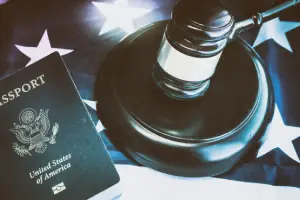 On May 21, 2026, US Citizenship and Immigration Services (USCIS) issued Policy Memorandum PM-602-0199. A USCIS spokesperson stated that going forward, temporary visa holders looking for a green card will have to return to their home countries to complete their application, barring “extraordinary circumstances.”
Within twenty-four hours, mainstream headlines across the country picked up on it, framing the memo as a sweeping structural overhaul. Closer inspection of the text shows that it’s a lot more complicated as far as administration is concerned.
The memorandum doesn’t alter statutory law or formally eliminate what we call adjustment of status (AOS). What it does is it instructs adjudicating officers to apply a higher scrutiny to the discretionary component of the application.
The quick way to put it is that Policy Memorandum PM-602-0199 changes the baseline expectations for legal immigration processing in the US. But to understand the mechanics behind it, you need to separate the statutory eligibility for green cards from the administrative authority to grant it within the country’s borders: under Section 245 of the Immigration and Nationality Act (INA), individuals who entered the country legally and maintain valid nonimmigrant status are statutorily eligible to apply for an Adjustment of Status to permanent residency without leaving the country.
The administration’s shift depends on a nuance in immigration law that isn’t really new, but is historically underutilized: statutory eligibility does not guarantee approval. The final step of an AOS application has always rested on the determination by an officer that the applicant deserves a favorable judgment based on the totality of the circumstances.
Historically, what happened is that if an applicant met all statutory criteria and lacked a criminal record or history of immigration violations, a favorable exercise of discretion was treated as largely a matter of course. Trump’s memorandum fundamentally reverses this presumption.
Now, adjudicators are told to treat adjustment from within the United States as an exception rather than the rule, shifting the burden of proof onto the applicant to show why their case warrants an act of grace.
The policy memorandum gives very specific criteria for how officers should evaluate different categories of non-immigrant visa holders currently residing in the United States.
The H-1B (highly skilled specialty occupation) and L-1 (intracompany transferee) visa categories have been the standard pipeline for corporate immigration for a very long time. These are dual-intent visas, meaning holders may enter the US temporarily while simultaneously pursuing permanent residency.
The memo changes how these categories are viewed during the adjustment phase, and it says that “maintaining lawful status in a dual intent nonimmigrant category is not sufficient, on its own, to warrant a favorable exercise of discretion.” As a result, foreign professionals who have established careers and community ties in the US over several years under an approved employer-sponsored track face a new administrative hurdle.
To obtain an in-country approval, these applicants now have to provide a record of evidence:
International students and exchange visitors under F-1 and J-1 classifications encounter a more immediate administrative obstacle. As these categories are inherently non-dual-intent, applicants are now burdened with demonstrating a lack of immigrant intent during both their initial entry and any subsequent visa renewals.
The Trump administration maintains that educational or cultural visas are not intended to function as a procedural “stepping stone” toward permanent residency. Consequently, under these heightened scrutiny protocols, students transitioning from graduation to Optional Practical Training (OPT) who then seek to adjust status via employment or marriage must navigate rigorous inquiries concerning the specific evolution of their intent.
Traditionally, immediate relatives of US citizens, and especially spouses, have occupied the most protected category in American immigration law, with plenty of standard bars to adjustment waived. While the statutory waivers remain intact, the discretionary assessment does not.
Adjudicators are directed to conduct case-by-case reviews of the moral character and totality of compliance of the applicant. This means family-based applicants have to show a larger volume of evidence to prove the bona fides of their relationship and their societal contributions to avoid overseas processing.
The administration maintains that this policy pivot is rooted in two overarching objectives: the enhancement of administrative efficiency and the preservation of enforcement integrity.
From an operational vantage point, USCIS contends that domestic field offices are struggling under unsustainable backlogs spanning naturalization, humanitarian, and asylum sectors. By transferring the logistical weight of green card processing to Department of State consular posts, the agency seeks to reallocate internal resources to address these domestic delays.
Under this framework, the final adjudication is relocated to a US embassy or consulate in the applicant’s home country, effectively offloading the procedural burden from the domestic system.
Regarding enforcement, the administration frames the memorandum as a critical safeguard for compliance. USCIS leadership has said that when an Adjustment of Status is denied within the US, the individual is already physically present, increasing the likelihood of unauthorized overstays. Requiring the final phase of processing to occur abroad ensures that ineligible applicants remain outside US territory, thereby mitigating the administrative and logistical costs of domestic enforcement.
While the policy is framed as an administrative rebalancing, immigration attorneys, business groups, and policy analysts have identified several systemic friction points that complicate its implementation.
The main criticism of the memo is, and really, has almost always been, the capacity of the Department of State to absorb a sudden influx of green card adjudications. The US embassies and consulates worldwide are already experiencing significant interview backlogs, a situation compounded by the fact that the administration has paused or restricted visa services in several volatile or non-cooperative regions.
Forcing applicants to go through consular processing means that people have to leave their jobs and families in the US to travel abroad for interviews that may not be scheduled for months or even years. For applicants originating from countries where US consular services are currently suspended, the policy creates an operational impasse, leaving them with no clear pathway to complete their processing.
For the US business sector, particularly technology, engineering, and healthcare industries, the reliance on predictable immigration timelines is a factor in workforce planning. In fact, the US benefits so much from legal immigration to the point that foreign countries have historically had trouble keeping their best skilled workers and best minds on their side of the world.
With the memo, though, business advocacy organizations, including the Cato Institute, have expressed concern that the unpredictability introduced by the discretionary standard will disrupt long-term talent retention.
If an H-1B worker faces friction regarding whether they can adjust status domestically, or if they face the prospect of an indefinite stay abroad during processing, employers might struggle to keep highly specialized talent. Analysts suggest this could lead to a shift where multinational corporations choose to relocate key research and development divisions to jurisdictions with more predictable residency pathways, such as Canada or Western Europe.
We’ve also seen organizations like World Relief and HIA highlight the human cost of the policy’s baseline assumptions. Forcing family members of U.S. citizens to return to countries experiencing political instability or economic collapse to attend a visa interview introduces safety concerns and guarantees periods of family separation.
More than that, while the memo allows for “extraordinary circumstances” to justify an in-country adjustment, the administration hasn’t yet provided a standardized definition of what constitutes such circumstances. This lack of specificity means applicants and legal counsel are stuck in this limbo of navigating highly subjective adjudicatory outcomes.
Policy Memorandum PM-602-0199 represents a significant example of utilizing executive discretion to shape immigration outcomes without undergoing the legislative process required to amend the Immigration and Nationality Act. By changing the internal operating instructions for USCIS officers, the administration has effectively altered the operational reality of legal immigration.
The long-term impact of this policy will depend heavily on two factors: how strictly individual USCIS field offices apply the heightened scrutiny mandate, and how federal courts respond to the inevitable legal challenges from business coalitions and civil rights organizations. For now, the routine, bureaucratic pathway that thousands of foreign professionals and families used to transition into permanent residents has been replaced by a highly individualized, high-stakes discretionary review.
Is your workforce or visa track hit by the new heightened scrutiny policy? The routine administrative pipeline for adjusting status from within the U.S. has fundamentally changed. To overcome the new default preference for processing abroad, foreign professionals and corporate employers must strategically build extensive, bulletproof discretionary evidence.
Put four decades of immigration excellence in your corner. Contact our team at Lawit Law at (214) 609-2242 to audit your case file.